

Why Your Teen Shuts Down: Understanding Their Communication Style
Introduction – Why Your Teen Shuts Down
You ask your teen a simple question:
“How was your day?”
Silence. A shrug. A mumbled “fine.”
You try again:
“Did anything interesting happen at school?”
“Not really.”
Frustrating, right?
You want to connect with your teen, but every conversation feels like hitting a brick wall. You start wondering:
- Are they hiding something?
- Did I do something wrong?
- Why won’t they just talk to me?
Here’s the truth: Your teen isn’t shutting down because they don’t care. They shut down because their communication style isn’t being met.
💡 Some teens need space to process before responding.
💡 Some feel overwhelmed by too many questions.
💡 Some crave deeper conversations, while others prefer quick check-ins.
The secret to getting your teen to open up? Understanding their DISC personality type.
The DISC model reveals why your teen reacts the way they do and how to adapt your approach so conversations feel natural—not forced.
By the end of this post, you’ll understand:
✅ Why your teen shuts down in certain situations
✅ The four DISC communication styles and how they shape responses
✅ How to adjust your approach so your teen feels safe to talk
Let’s dive in.
Main Body
The Real Reason Your Teen Shuts Down
When your teen shuts down, avoids eye contact, or gives one-word answers, it’s easy to assume:
❌ They’re hiding something.
❌ They’re being difficult on purpose.
❌ They just don’t want to talk.
But in reality, most teens don’t shut down because they don’t care—they shut down because something in the conversation doesn’t feel right for them.
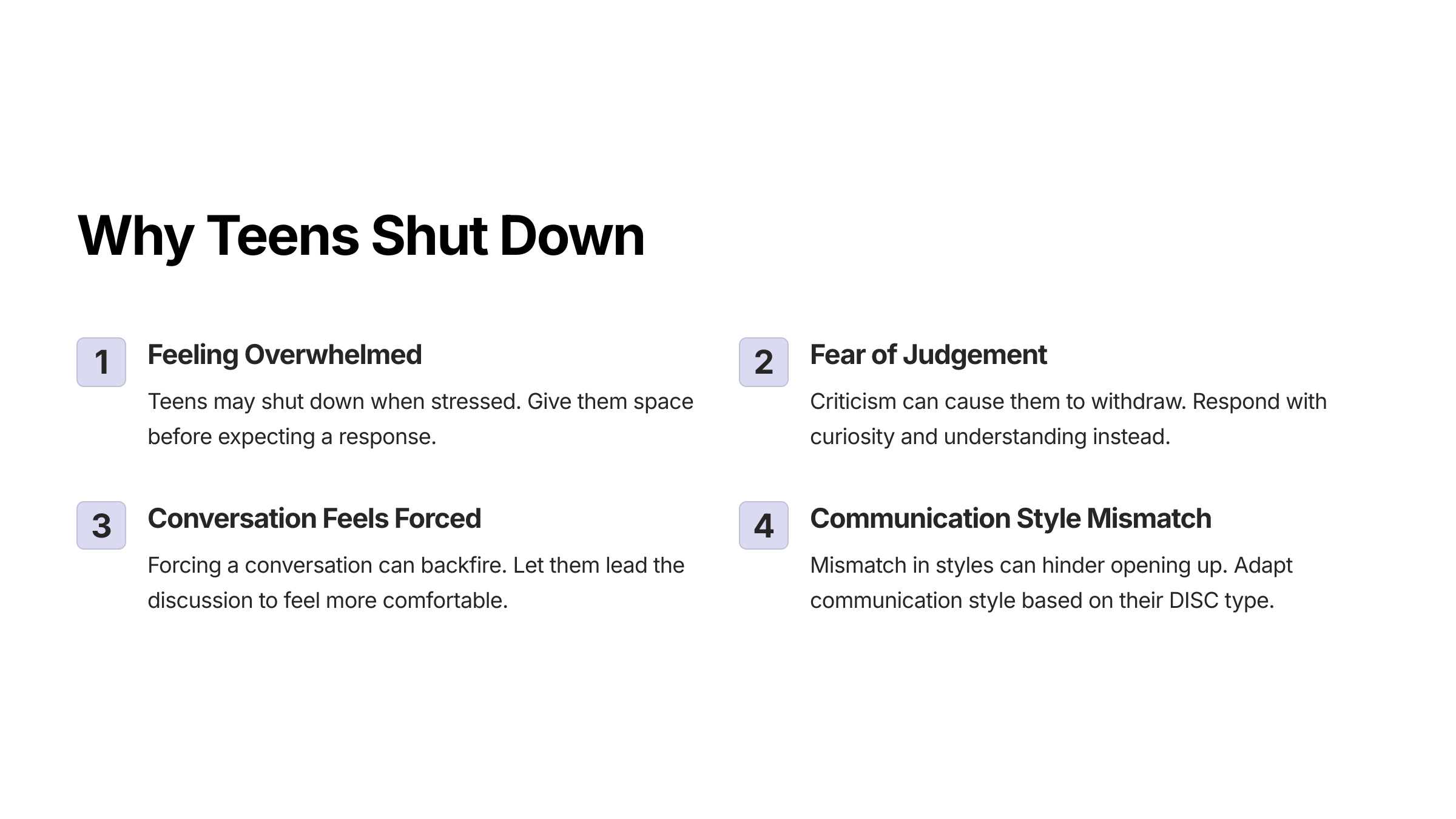
Here are some of the biggest reasons why teens retreat into silence:
1. They Feel Overwhelmed
Some teens need time to process before responding—especially if they’re dealing with stress, strong emotions, or tough topics. If they don’t have space to think, they may shut down instead.
💡 Common Triggers:
- Asking too many questions at once (“Tell me everything about your day.”)
- Pressuring them to answer immediately (“Why won’t you just talk to me?”)
- Bringing up big conversations when they’re already stressed
✅ What Helps:
- Give them time and space (“I’d love to hear about your day when you’re ready.”)
- Let them process before expecting a response (“Take your time. No rush.”)
2. They Fear Judgment or Disapproval
Teens often worry about saying the wrong thing or disappointing their parents. If they think you’ll criticize, lecture, or react negatively, they might shut down to avoid conflict.
💡 Common Triggers:
- Responding with immediate advice or correction (“You should have done this instead.”)
- Using a harsh or critical tone (“What were you thinking?”)
- Jumping to conclusions before hearing them out
✅ What Helps:
- Respond with curiosity, not criticism (“That sounds tough—what do you think you’ll do next time?”)
- Show you’re listening without judgment (“I hear you. That makes sense.”)
3. They Don’t Feel Like the Conversation is Theirs
Some teens don’t enjoy being put on the spot. If a conversation feels like an interrogation, they’ll withdraw to escape the pressure.
💡 Common Triggers:
- Too many back-to-back questions (“Who was there? What did they say? How did you feel?”)
- Interrupting before they’ve finished their thoughts
- Not letting them lead—only asking what you want to know
✅ What Helps:
- Give them control over the conversation (“What’s on your mind today?”)
- Let them set the pace—silence isn’t always a bad thing!
4. Their Communication Style is Different from Yours
Not all teens process and express emotions the same way. A teen who needs direct, to-the-point communication will struggle with long, emotional discussions—while a teen who values deep connection may shut down when conversations feel too surface-level.
💡 Common Triggers:
- Talking too much when they prefer short answers
- Being too blunt when they need gentle encouragement
- Pushing for deep conversations when they prefer to keep things light
✅ What Helps:
- Adapt to their communication style instead of expecting them to match yours.
This is where the DISC model comes in.
Next, let’s break down the four DISC communication styles—so you can identify which one best describes your teen and how to connect with them in a way that feels natural.
The 4 DISC Communication Styles in Teens
Every teen processes conversations differently. Some need direct communication, while others prefer a slow, thoughtful approach. Some shut down when pressured, while others push back when they feel controlled.
Understanding your teen’s DISC communication style helps you adjust your approach—so they feel comfortable opening up.
Let’s break down the four DISC types and how they naturally communicate:
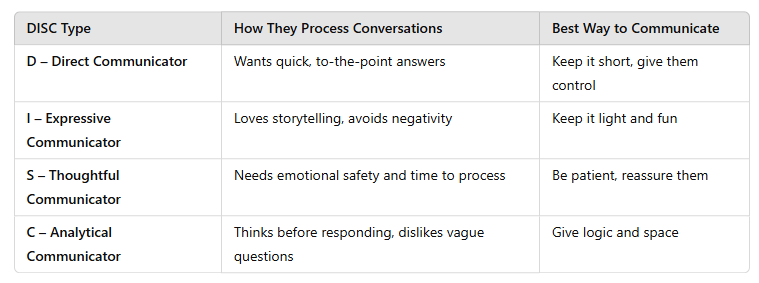
1. D – The Direct Communicator (Dominance)
🔥 Personality Traits: Bold, independent, strong-willed, to the point
🚪 Why They Shut Down: When they feel controlled, lectured, or talked down to
💡 What They Need: Direct, efficient communication that respects their autonomy
How to Recognize a D-Type Teen:
✅ They like control and challenge authority
✅ They push back if they feel disrespected
✅ They hate long explanations—they want you to get to the point
How to Communicate with Them:
✔️ Be direct and confident (“I need your help with this.”)
✔️ Give them choices (“Would you rather do your homework before or after dinner?”)
✔️ Avoid power struggles—don’t try to “win” an argument
❌ What NOT to Do:
- Don’t lecture or talk in circles (“You need to do this because I said so.”)
- Don’t challenge them aggressively—they’ll fight back (“You have no say in this.”)
2. I – The Expressive Communicator (Influence)
🎉 Personality Traits: Social, talkative, enthusiastic, easily distracted
🚪 Why They Shut Down: When conversations feel boring, critical, or overly serious
💡 What They Need: Positivity, engagement, and a lighthearted approach
How to Recognize an I-Type Teen:
✅ They love telling stories but may jump from topic to topic
✅ They avoid negative conversations—they’d rather keep things fun
✅ They crave social interaction and approval
How to Communicate with Them:
✔️ Keep conversations light and engaging (“Tell me the funniest thing that happened today!”)
✔️ Use positive reinforcement (“I love hearing your ideas.”)
✔️ Make talking fun—walk, play a game, or chat while doing something active
❌ What NOT to Do:
- Don’t criticize them too harshly—they’ll shut down (“You’re always so distracted.”)
- Don’t be too serious too often—balance deep talks with fun moments
3. S – The Thoughtful Communicator (Steadiness)
💙 Personality Traits: Kind, loyal, conflict-avoidant, emotionally sensitive
🚪 Why They Shut Down: When they feel rushed, pressured, or sense conflict
💡 What They Need: A calm, patient, and emotionally safe conversation
How to Recognize an S-Type Teen:
✅ They rarely start arguments and prefer keeping the peace
✅ They need time to process before sharing their thoughts
✅ They shut down when they sense tension or pressure
How to Communicate with Them:
✔️ Give them space to think (“No rush—whenever you’re ready to talk, I’m here.”)
✔️ Reassure them (“You’re not in trouble—I just want to understand.”)
✔️ Create a safe, low-pressure environment (talk during a quiet activity, like a car ride)
❌ What NOT to Do:
- Don’t demand immediate answers (“Tell me right now what happened.”)
- Don’t raise your voice—they’ll withdraw further
4. C – The Analytical Communicator (Conscientiousness)
🧠 Personality Traits: Logical, detail-oriented, perfectionistic, deep thinker
🚪 Why They Shut Down: When conversations are too emotional, vague, or rushed
💡 What They Need: Clear, logical communication with time to process
How to Recognize a C-Type Teen:
✅ They ask a lot of questions and like to understand details
✅ They hate vague or unclear instructions
✅ They take their time answering and prefer to think before speaking
How to Communicate with Them:
✔️ Give logical explanations (“Here’s why I think this is important.”)
✔️ Let them process before expecting a response (“Think about it, and let’s talk later.”)
✔️ Respect their need for structure and accuracy
❌ What NOT to Do:
- Don’t rush them—they need time to think (“Just answer me already.”)
- Don’t expect emotional responses (“Why don’t you ever open up?”)
The Bottom Line:
Your teen’s communication style influences how they react in conversations.
🚪 If they shut down, it’s not because they don’t care—it’s because something in the conversation doesn’t feel right for them.
✅ D-Type teens need control and directness.
✅ I-Type teens need positivity and engagement.
✅ S-Type teens need emotional safety and patience.
✅ C-Type teens need logic and time to process.
Now that you know why they shut down, let’s talk about how to adjust your approach to get them talking again.
How Each DISC Type Responds to Conflict & Conversation
Every teen processes conflict and tough conversations differently. Some push back, some avoid, and some overanalyze. Understanding their DISC communication style helps you anticipate their response—so you can navigate conversations with less resistance and more connection.
Here’s how each DISC type handles conflict and deep conversations—and what works best when communicating with them.
1. D-Type Teens (The Direct Communicator)
🔥 How They Handle Conflict:
- Challenge authority if they feel controlled.
- Push back aggressively if they think they’re being treated unfairly.
- Want to win—they see conflict as a competition.
💡 What Works:
✔️ Be direct and to the point (“I need you to listen to me for a minute.”)
✔️ Give them control (“Would you rather talk about this now or later?”)
✔️ Stay calm and firm—don’t engage in a power struggle.
🚫 What NOT to Do:
- Don’t lecture or talk in circles (“Let me explain this again for the fifth time.”)
- Don’t try to dominate the conversation—they’ll push back harder.
2. I-Type Teens (The Expressive Communicator)
🎉 How They Handle Conflict:
- Try to avoid negativity—they don’t like tense conversations.
- Deflect with humor to escape uncomfortable topics.
- Get emotional quickly—they take things personally.
💡 What Works:
✔️ Keep the tone light—avoid coming in too harsh.
✔️ Use positive reinforcement (“I love when we work through things together.”)
✔️ Give them space to express themselves—they need to talk it out.
🚫 What NOT to Do:
- Don’t shut them down with criticism (“You’re too dramatic.”)
- Don’t get too serious too fast—ease into tough conversations.
3. S-Type Teens (The Thoughtful Communicator)
💙 How They Handle Conflict:
- Avoid arguments at all costs.
- Withdraw emotionally when overwhelmed.
- Prefer to keep the peace rather than express frustration.
💡 What Works:
✔️ Give them time to process (“I know this is a lot—take a minute.”)
✔️ Reassure them that conflict is okay (“I’m not upset, I just want to understand.”)
✔️ Create a safe, calm space for open dialogue.
🚫 What NOT to Do:
- Don’t force them to talk before they’re ready.
- Don’t raise your voice or create tension—they’ll shut down completely.
4. C-Type Teens (The Analytical Communicator)
🧠 How They Handle Conflict:
- Need time to think before responding.
- Want logical explanations—emotional arguments frustrate them.
- Get stuck in analysis paralysis if overwhelmed.
💡 What Works:
✔️ Give them space to process (“Take your time thinking this through.”)
✔️ Stick to facts, not emotions (“Here’s why I’m concerned…”)
✔️ Respect their need for structure—they like clear expectations.
🚫 What NOT to Do:
- Don’t expect an immediate emotional response (“Why don’t you ever react?”)
- Don’t force them to respond quickly—they need time to think.
The Bottom Line:
🗝️ If your teen shuts down during conflict, it’s not about disobedience—it’s about how they process information.
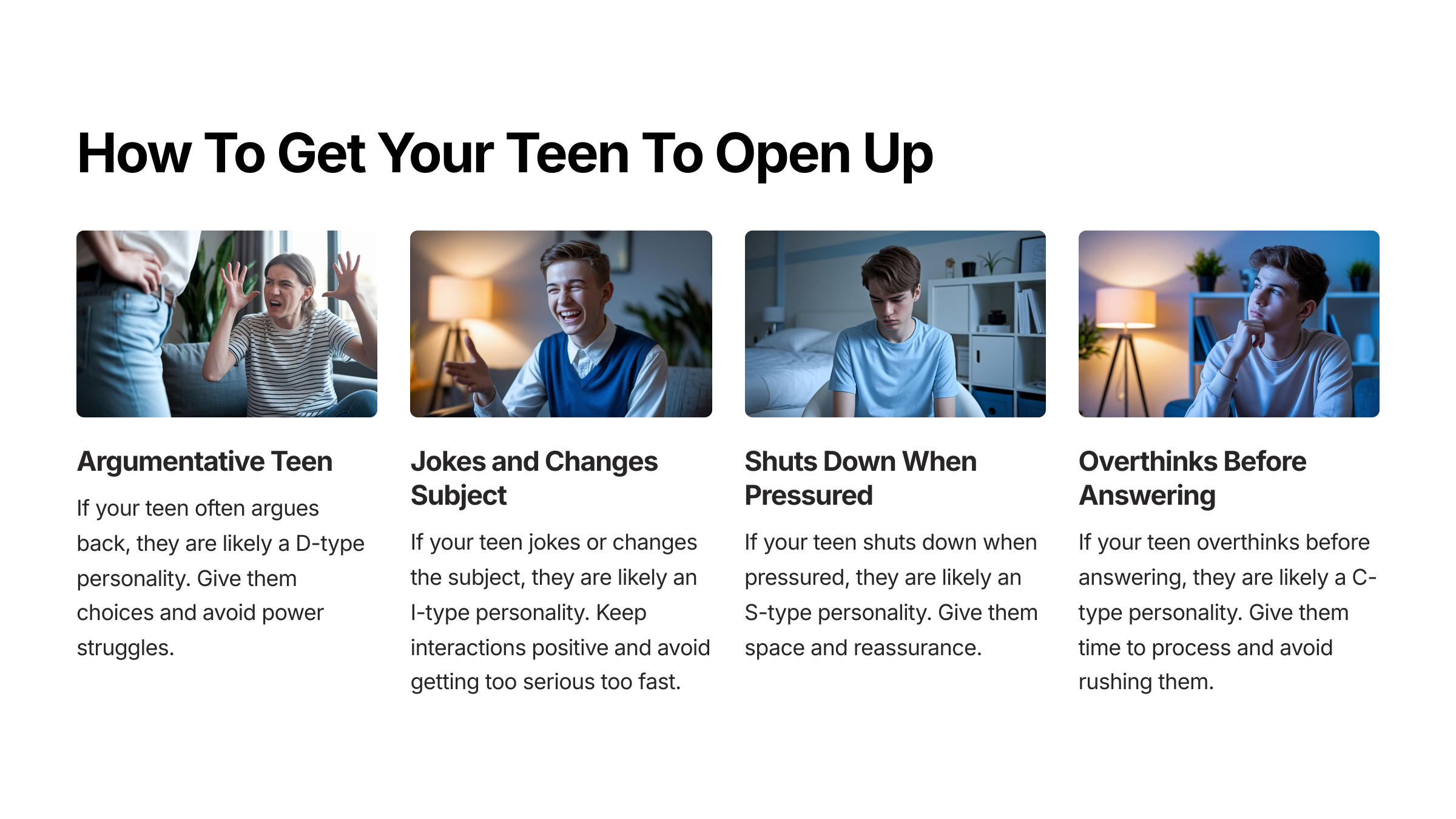
✅ D-type teens argue back when they feel controlled—give them choices instead of demands.
✅ I-type teens avoid negativity—approach them with positivity and humor.
✅ S-type teens withdraw from pressure—give them time and emotional safety.
✅ C-type teens overthink things—give them logical explanations and space to process.
Now that you know how they handle tough conversations, let’s talk about how to get them to open up in everyday interactions.this strategy work.
How to Get Your Teen to Open Up (Based on Their DISC Type)
Now that you understand how your teen processes conversations and conflict, let’s talk about how to encourage them to open up.
Each DISC type has a unique way of communicating, and adjusting your approach makes a huge difference in whether they feel comfortable sharing with you.
Here’s how to connect with them in a way that feels natural, not forced.
1. D-Type Teens (The Direct Communicator)
🔥 Why They Struggle to Open Up:
- They don’t like feeling vulnerable or being told what to do.
- They won’t talk if they feel you’re trying to control them.
💡 How to Get Them Talking:
✔️ Be direct and efficient—skip the long speeches.
✔️ Give them a sense of control (“I’d love your take on this.”)
✔️ Respect their independence—don’t push too hard.
What Works Best:
- Let them lead the conversation (“What’s your opinion on this?”)
- Keep it short and to the point (“Tell me in one sentence—how was your day?”)
- Let them solve problems instead of offering advice.
🚫 What NOT to Do:
- Don’t pry for details—they’ll shut down.
- Don’t lecture or dominate the conversation.
2. I-Type Teens (The Expressive Communicator)
🎉 Why They Struggle to Open Up:
- They don’t like negative conversations—they avoid heavy topics.
- They get easily distracted and may forget what they were saying.
💡 How to Get Them Talking:
✔️ Make it fun and engaging (“Tell me the most exciting thing that happened today!”)
✔️ Use positive reinforcement (“I love hearing your stories.”)
✔️ Let them talk freely—don’t rush or redirect them too much.
What Works Best:
- Ask open-ended, playful questions (“If today was a movie, what would the title be?”)
- Keep it casual and light—don’t turn every conversation into a serious one.
- Let them share at their own pace—they love to talk when they’re comfortable.
🚫 What NOT to Do:
- Don’t shut them down with negativity (“That’s not important.”)
- Don’t force a serious talk when they aren’t in the right mindset.
3. S-Type Teens (The Thoughtful Communicator)
💙 Why They Struggle to Open Up:
- They need emotional safety before they’ll share.
- They shut down if they feel pushed, rushed, or pressured.
💡 How to Get Them Talking:
✔️ Create a safe, calm space (“No rush, I just love hearing your thoughts.”)
✔️ Be patient and gentle—give them time to process before responding.
✔️ Use reassurance (“You’re not in trouble—I just want to understand.”)
What Works Best:
- Low-pressure environments (e.g., talking while driving or during a quiet activity).
- Giving them time to think before expecting a response.
- Validating their feelings (“I can see why that was tough.”).
🚫 What NOT to Do:
- Don’t push for immediate answers—they need time to process.
- Don’t raise your voice or use an aggressive tone.
4. C-Type Teens (The Analytical Communicator)
🧠 Why They Struggle to Open Up:
- They need time to process before responding.
- They shut down when conversations feel too emotional or unpredictable.
💡 How to Get Them Talking:
✔️ Give them time to think (“I’d love to hear your thoughts when you’re ready.”)
✔️ Use logic, not just emotion (“Let’s go over what happened step by step.”)
✔️ Respect their need for clarity—they hate vague questions.
What Works Best:
- Give them a heads-up before big talks (“I’d love to check in later about school.”).
- Let them write things down first if they struggle to verbalize.
- Stick to facts and avoid emotional pressure.
🚫 What NOT to Do:
- Don’t demand instant responses—they need time to think.
- Don’t expect emotional expression—they process differently.
Your Teen WANTS to Talk—They Just Need the Right Approach
🚪 If your teen shuts down, it’s not because they don’t want to talk—it’s because they need a conversation style that fits their personality.
✅ D-type teens open up when they feel respected and in control.
✅ I-type teens open up when conversations feel fun and engaging.
✅ S-type teens open up when they feel emotionally safe.
✅ C-type teens open up when given time to think.
Try This Today:
1️⃣ Think about your teen’s personality—what DISC type do they seem to fit?
2️⃣ Try adjusting one small part of your communication style to match their needs.
3️⃣ Observe the difference in their response.
💡 Want help identifying your teen’s communication style? Download my free DISC Style Quiz to discover their personality type and get personalized strategies. subscribepage.io/discstylequiz
Next, let’s go over common mistakes parents make when trying to talk to their teen—so you can avoid them and see results faster..
Common Mistakes Parents Make When Talking to Their Teen
Even with the best intentions, parents often accidentally shut down conversations without realizing it.
If your teen isn’t opening up, it’s not always because they don’t want to—it could be because something in your approach isn’t working for their communication style.
Here are the most common mistakes parents make—and how to fix them.
1. Forcing Conversations at the Wrong Time
❌ Mistake: Trying to talk when your teen is tired, distracted, or not in the mood.
✔️ Better Approach: Find natural moments when they’re more receptive.
💡 Example:
- Instead of asking deep questions right after school, wait until they’ve had time to decompress.
- Try talking during car rides or while doing an activity together.
✅ Best for: S-Type & C-Type Teens (who need time to warm up).
2. Using Too Many Words (or Too Few!)
❌ Mistake:
- D-type and C-type teens tune out long explanations.
- S-type and I-type teens need a little warmth and detail to feel engaged.
✔️ Better Approach: Match your teen’s preferred communication style.
💡 Example:
- A D-type teen prefers: “We need to talk—let’s make this quick.”
- An I-type teen responds better to: “Hey! Let’s grab some ice cream and chat.”
✅ Best for: All DISC types—adjust based on their needs.
3. Lecturing Instead of Listening
❌ Mistake: Jumping in with advice or talking at your teen instead of letting them express themselves.
✔️ Better Approach: Ask open-ended questions and actually listen.
💡 Example:
- Instead of “You should have handled that differently,” try: “What do you think you’ll do next time?”
- Instead of “You always do this,” try: “Tell me what was going through your mind.”
✅ Best for: S-Type & I-Type Teens (who need to feel emotionally safe).
4. Not Recognizing Their Need for Control
❌ Mistake:
- D-type and C-type teens shut down when they feel forced into a conversation.
✔️ Better Approach: Give them choices so they feel in control.
💡 Example:
- Instead of “We need to talk NOW,” try: “Would you rather talk now or after dinner?”
- Instead of “Tell me how you feel,” try: “Would it be easier to write it down first?”
✅ Best for: D-Type & C-Type Teens (who value autonomy).
5. Expecting the Same Response from Every Child
❌ Mistake: Thinking that what works for one child should work for another.
✔️ Better Approach: Adjust based on their personality.
💡 Example:
- One child might need a long heart-to-heart.
- Another child may prefer a quick text or short check-in.
✅ Best for: All DISC types—every child is different!
The Bottom Line:
🚪 If your teen isn’t talking, it doesn’t mean they don’t want to—it means they need a different approach.
✅ D-type teens need direct, to-the-point communication.
✅ I-type teens need fun, lighthearted engagement.
✅ S-type teens need emotional safety and patience.
✅ C-type teens need logic, structure, and processing time.
Try This Today:
1️⃣ Notice when your teen is most willing to talk.
2️⃣ Adjust your communication style to match theirs.
3️⃣ Avoid the mistakes above and see how your teen responds.
💡 Want help identifying your teen’s communication style? Download my free DISC Style Quiz to discover their personality type and get personalized strategies. subscribepage.io/discstylequiz
Next, let’s wrap this all up with a final takeaway and an action step you can try today!
Conclusion: Building Better Conversations with Your Teen
Parenting a teen can feel like a constant guessing game—one day they’re talkative, the next day they shut down completely. But now, you have a roadmap to understanding why.
Your teen isn’t ignoring you on purpose—they just have a unique way of processing communication.
🚪 If they shut down, it’s not because they don’t want to talk—it’s because something in the conversation doesn’t feel right for them.
✅ D-type teens open up when they feel respected and in control.
✅ I-type teens open up when conversations feel fun and engaging.
✅ S-type teens open up when they feel emotionally safe.
✅ C-type teens open up when given time to process and clear expectations.
When you adjust your communication to fit their style, you’ll notice:
✔️ Fewer misunderstandings
✔️ More natural conversations
✔️ A stronger, more trusting relationship
Your Next Step: Try This Today!
✅ Think about your teen’s personality—what DISC type do they seem to fit?
✅ Try adjusting one small part of your communication style to match their needs.
✅ Observe how they respond—small changes can lead to big improvements!
💡 Want a step-by-step guide? Download my free DISC Style Quiz to discover your teen’s communication style and get personalized strategies for better conversations. subscribepage.io/discstylequiz
💬 I’d love to hear from you! What DISC type best describes your teen? Drop a comment below and let’s chat!
0 Comments