

Introduction: The Silent Drift
You used to know everything — what their laugh sounded like when they told you about their day, what snack they’d grab after school, how they curled up next to you on the couch like it was the safest place on earth.
Now?
You get a slammed door. A grunt. Maybe an eye roll if you’re lucky.
It feels like your teen has morphed into someone you don’t recognize. And the hardest part? You have no idea how to get them back — and it’s killing you inside.
You’re not alone, and you’re not failing. The truth? You’ve just been trying to speak a language they can’t hear.
Enter DISC — not a corporate buzzword, not some quiz fluff — but a game-changing parenting strategy that meets your child exactly where they are… even if where they are is locked in their room with AirPods in.
In this post, I’m going to break down exactly how DISC helps you reconnect with your teen — not through therapy, not through bribes, and not by giving up your authority — but through real, repeatable communication strategies that actually land.
Because they do still need you.
They just need you to speak their language.
Main Body
What Is DISC? (Without the Corporate Jargon)
If you’ve ever felt like your teen is on a different planet — guess what? They kinda are. And DISC is the map.
DISC is a personality framework that helps you understand how people communicate, process stress, and make decisions — without guessing, begging, or reading their mind. And when it comes to teens? It’s like finding the instruction manual they didn’t come with.
Here’s the no-fluff breakdown:
- D = Dominant
Think: direct, independent, wants control. Hates being told what to do.
Needs: Respect, bottom-line talk, fast decisions. - I = Influencer
Think: social, expressive, lives for approval. Hates being ignored.
Needs: Praise, connection, fun energy. - S = Steady
Think: calm, loyal, hates conflict. Shuts down during drama.
Needs: Reassurance, time to process, safety. - C = Conscientious
Think: logical, detailed, perfectionist. Hates being wrong.
Needs: Clarity, time, trust in their intellect.
Every teen leads with one or two of these styles. And so do you. That’s the power — DISC doesn’t just help you understand your teen. It helps you see how you show up too.
So instead of clashing or shutting down, you learn how to adjust your delivery without losing your authority — and connection finally feels doable again.
#1: You Stop Talking to a Wall
You’ve said it a hundred times:
“I’m just trying to talk to you.”
And they respond with… silence. A grunt. Or worse — a full-blown explosion over literally nothing.
Here’s the truth: you’re not being ignored… you’re just not being heard. Not in the way they need.
Each DISC type hears communication differently:
- Your D teen hears efficiency. They need direct, respectful language without long explanations or emotional spirals. Keep it short, confident, and clear.
- Your I teen hears enthusiasm. They need eye contact, energy, and connection before they hear instruction. Lead with warmth, then go into details.
- Your S teen hears tone first. If you sound rushed or irritated, they’ll shut down — even if your words are kind. Calm and consistent wins.
- Your C teen hears logic. They need reasons, steps, and space to think. If you rush them or come in hot emotionally, they’ll pull away.
DISC gives you the cheat codes. You stop repeating yourself. You stop yelling. And most of all? You stop taking it personally when they don’t respond right away — because now, you’re speaking their language.
And that changes everything.
#2: You Learn Their Triggers — and Avoid Landmines
Ever feel like you stepped on an emotional landmine and had no idea what set it off?
One second you’re asking a simple question like, “Did you finish your homework?”
The next? BOOM. You’re caught in a whirlwind of eye rolls, slammed doors, or total emotional shutdown.
Here’s the hard truth: it’s not always what you say — it’s how they’re wired to hear it. And that’s where DISC changes the game.
Each DISC type has built-in triggers — and when you don’t know what they are, you trip them without even trying:
- D types get triggered by feeling powerless or micromanaged.
“You better…” or “Why didn’t you…” = instant shutdown. - I types get triggered by rejection or being left out.
Ignoring them or being “all business” kills connection fast. - S types get triggered by conflict, pressure, or rushed decisions.
Sudden changes or harsh tones send them into retreat mode. - C types get triggered by criticism or chaos.
Vague requests, last-minute plans, or emotionally-charged convos = instant overload.
When you understand their DISC triggers, you stop walking on eggshells — because you finally know where the eggshells are.
This isn’t about being perfect. It’s about being aware — and that awareness becomes your greatest parenting tool.
#3: You Use the Right Tone, Not Just the Right Words
Words matter, but your tone is everything. You could say “I love you,” but if your tone sounds frustrated, dismissive, or even passive, your teen’s brain is not registering love. It’s registering tension, criticism, or worse, disconnection.
Here’s the kicker: DISC types hear tone in radically different ways. Understanding this is the key to getting through — without having to shout or pull your hair out.
- D types need a direct, confident tone. If you come at them with a pleading or uncertain tone, they’ll feel challenged and defensive.
“I need you to do this now” works much better than, “Could you please…?” - I types need a friendly, upbeat tone. They respond to energy and warmth, so a neutral or cold tone feels like rejection.
“I love that you’re helping with that!” hits way better than, “Are you done yet?” - S types need a calm, steady tone. If you’re hurried, irritable, or raise your voice, they feel overwhelmed and close off.
“I’ve got this covered, take your time” works wonders. - C types need a logical, clear tone. They need to know what’s happening, why it’s happening, and what they’re expected to do next.
“Here’s why this matters, and here’s how we’re going to handle it” resonates more than a rushed “just do it.”
When you understand your teen’s DISC type, you can tailor your tone to match their emotional wiring, instead of triggering a reaction that shuts the conversation down before it even starts.
#4: You Rebuild Trust Without Needing Them to “Open Up” First
Here’s a trap most parents fall into (and no shade, because it’s SO common):
“I’ll reconnect with them… when they’re ready to talk.”
But what if that moment doesn’t come? What if silence becomes the new normal?
Here’s the truth: your teen doesn’t need to talk in order for you to start rebuilding trust.
They need to feel something first — safety. Respect. Non-judgment.
That’s where DISC becomes your secret weapon. Because instead of waiting for them to open up, you learn how to create a safe space they actually want to step into — without forcing it.
Here’s how it works:
- A D type feels trust when you treat them like a decision-maker. Give them choices. Respect their opinions.
- An I type trusts when you see the person, not just the behavior. Laugh with them, not at them.
- An S type needs consistency. Trust builds when your reactions don’t shift with your mood.
- A C type builds trust slowly. Let them process — don’t rush the conversation.
When you start parenting to their style — not your fear — trust starts showing up in the little moments: a pause before they snap back, a softening of their tone, a random “thanks” you weren’t expecting.
You don’t have to wait for them to “come around.”
You get to go first.
#5: You Shift From Power Struggle to Power Duo
If parenting your teen feels like a constant battle for control, you’re not alone.
You ask a question, they get defensive.
You set a boundary, they push harder.
You try to connect, they shut down.
Sound familiar?
That’s the power struggle loop — and the more you fight to win, the more both of you lose. But here’s the shift: what if parenting wasn’t about dominance… but partnership?
DISC helps you move from controlling to collaborating — without giving up your authority.
Let me be clear:
This isn’t about being your teen’s BFF.
It’s about becoming the leader they’ll actually follow — because they trust you, not because they fear you.
Each DISC type wants a different kind of partnership:
- D types want a say. Give them roles and responsibilities that matter.
- I types want connection. Make hard convos feel like teamwork, not confrontation.
- S types want peace. Bring calm leadership to emotional chaos.
- C types want clarity. Walk them through logic, not just rules.
When your teen sees that you’re willing to meet them where they are — while still holding the line — the game changes.
You’re not opponents anymore.
You’re a power duo.
#6: You Become the Parent They Need — Not the One You Think You Should Be
You’re doing everything you thought you were supposed to do.
You’re setting boundaries. You’re trying to talk things out. You’re giving space, offering support, holding back the full meltdown you feel brewing inside.
But something still isn’t working. And it’s not because you’re a bad mom — it’s because you’re parenting from assumption, not alignment.
Most of us were raised to believe that good parenting meant being firm, fair, and consistent. But what if your teen doesn’t respond to “firm”? What if “fair” to you feels like pressure to them?
DISC reveals something most parenting books don’t:
There’s no one-size-fits-all when it comes to leadership. Especially with teens.
What works for one type completely backfires on another:
- A D teen needs challenge and control — but if you’re too passive, they’ll walk all over you.
- An I teen craves connection — but if you go all “tough love,” they’ll spiral into feeling unloved.
- An S teen needs emotional safety — but if you parent with chaos, they’ll emotionally disappear.
- A C teen needs logic and consistency — but if you constantly change the rules, they’ll lose trust fast.
When you use DISC, you start seeing your teen — not just reacting to them.
You stop guessing.
You start leading with intention.
And that’s when you finally become the parent they’ve needed all along.
Real-World Shift: From Shutdowns to Side-by-Side
Let me tell you about Kaycee.
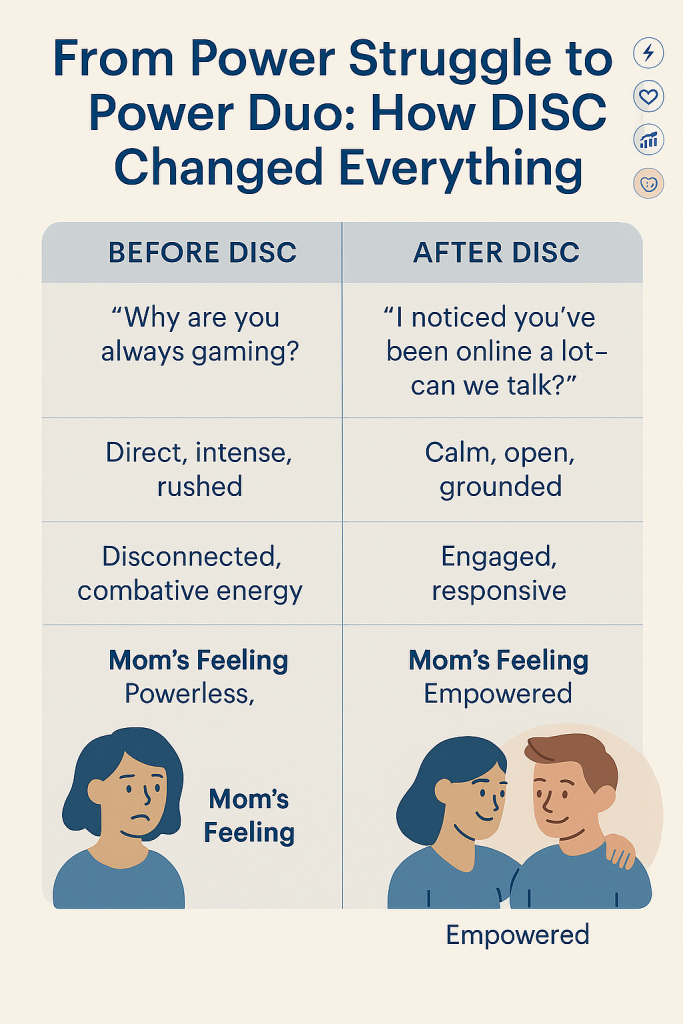
Kaycee came to me defeated. Her 22-year-old son spent most of his days locked in his room playing video games. Every time she tried to bring up jobs, goals, or literally anything outside of gaming, he’d shut down.
No eye contact. No conversation. Just avoidance.
She was ready to lose it.
Kaycee is a classic D type — direct, driven, solution-focused. Her son? S type — steady, sensitive, hates conflict, and retreats under pressure.
The problem wasn’t love. It was delivery.
She was parenting him like a D. He needed to be led like an S.
So we made small shifts:
- She swapped intensity for calm reassurance.
- She stopped pushing, and started inviting him into conversations.
- She validated his love for gaming before asking about next steps.
- She let silence breathe instead of trying to force a breakthrough.
In two weeks, everything changed.
He started asking her for advice.
He lined up multiple job interviews.
He even cut back on gaming — on his own.
And Kaycee? She said this:
“I finally feel like we’re on the same team again.”
That’s what DISC does.
It doesn’t just change behavior.
It restores connection.
Common Objections (And the Truth That Shuts Them Down)
et’s be real — if you’re a parent who’s been through the ringer, your guard is up. You’ve tried things. You’ve read books. You’ve listened to podcasts. And still, your teen feels like a stranger.
So when I say DISC can help?
You’re probably thinking:
“I’ve read every parenting book on the shelf — why would this be different?”
Because this isn’t a theory. This is strategy. It’s not about long-winded advice or scripts to memorize — it’s about decoding your teen’s behavior and adjusting how you lead. And it works even if nothing else has.
“DISC? Isn’t that some personality quiz fluff?”
Nope. DISC isn’t fluff — it’s a framework used by CEOs, coaches, and yes, smart parents who are DONE with guessing. It’s not about labeling your teen. It’s about understanding them.
“My teen barely makes eye contact — there’s no way this would work.”
Exactly why it does. DISC works even when words don’t. You’ll know how to lead with energy, tone, and timing — all without waiting for them to “want to talk.”
“I’m scared to get my hopes up again.”
Totally fair. But what if this time… it works? What if all that heartbreak wasn’t a dead end — but a detour to the real way through?
You don’t need perfect conditions.
You just need a better map.
Conclusion: It Was Never About “Fixing” Them
If you’ve made it this far, you’re not just a parent — you’re a fighter.
You’re the mom who still shows up even when the door slams.
You’re the dad who keeps trying, even when every word feels like a minefield.
You’re the leader in your home who refuses to believe the distance is permanent.
The truth is, this was never about “fixing” your teen. It’s about seeing them.
And it’s about giving yourself the tools to lead without losing your mind — or your connection.
DISC doesn’t change your kid.
It changes the way you reach them.
It helps you stop second-guessing every conversation.
It helps you decode silence, defuse blowups, and rebuild trust without begging for it.
It helps you become the parent they actually need — not the one your fear or frustration keeps defaulting to.
And the best part? You don’t have to wait for them to “come around.”
You get to go first. You get to lead differently. And when you do…
They feel it.
And that’s when everything starts to change.
Ready to Decode Your Teen
If you’re nodding your head right now thinking,
“This is exactly what I’ve been missing…”
It’s time to stop parenting in the dark.
The DISC Decoder for Parents is your step-by-step guide to understanding your teen’s behavior, communication style, and emotional needs — without therapy, conflict, or guesswork.
You’ll get:
- A quick DISC assessment for YOU and your teen
- Breakdowns of what each type needs (and what shuts them down)
- Conversation starters that actually land
- Real-world strategies to rebuild trust and connection
You don’t need another parenting book.
You need a decoder ring — and this is it.
Grab the DISC Decoder for Parents now:
https://coachwilkes.com/discdecoder/
Let’s turn power struggles into powerful connection — starting today.
0 Comments