
Using Implementation Intentions to Stay Consistent With Your Parenting Goals
Introduction
Every parent has been there.
You decide you’re going to stay calm when your teen rolls their eyes at you.
You promise yourself you won’t give in to another late-night video game request.
You commit to having meaningful conversations instead of nagging.
And then… life happens.
In the heat of the moment, your best intentions slip away. You react instead of responding. You let things slide out of exhaustion. And later, you wonder: Why can’t I stick to my parenting goals?
The problem isn’t that you don’t care or that you lack willpower. The real issue? You don’t have a plan for the moments when it matters most.
That’s where implementation intentions come in.
This simple, science-backed strategy helps you follow through on your parenting goals—even when emotions run high. Instead of relying on willpower, you’ll create automatic responses that guide you in the moment.
By the end of this post, you’ll have a powerful tool to help you stay consistent, reduce parenting stress, and create lasting change in how you show up for your teen.
Let’s dive in.
Main Body
What Are Implementation Intentions?
Have you ever told yourself, “Next time, I’ll do better”—only to fall back into the same habits?
It’s not because you’re a bad parent or lack self-control. It’s because intentions alone aren’t enough.
Implementation intentions are a research-backed strategy that helps turn goals into automatic actions. They work by using a simple “If-Then” formula to pre-plan your response in specific situations.
Instead of hoping you’ll remember to stay calm or make a better choice, you create a mental shortcut:
✅ If my teen ignores me, then I will place my hand on their shoulder before speaking.
✅ If my teen talks back, then I will take a deep breath before responding.
✅ If I notice my child withdrawing, then I will invite them for a short walk together.
This technique is based on psychology research that shows we’re more likely to follow through on a behavior when we’ve already planned exactly when and how we’ll do it.
In short, implementation intentions take the guesswork out of parenting. Instead of trying to make the right choice in the heat of the moment, you already have a plan in place—making it easier to stay calm, connected, and consistent.
Next, let’s talk about why parents struggle with consistency in the first place—and how this simple shift can help.
Why Parents Struggle With Consistency
You know what you want to do—so why is it so hard to actually do it?
Most parents struggle with consistency for a few key reasons:
1. Overwhelm: Too Many Parenting Strategies to Remember
There’s no shortage of parenting advice out there. You read books, listen to podcasts, and try new techniques—but in the heat of the moment, it all flies out the window. When you’re juggling a million responsibilities, it’s impossible to remember every strategy on demand.
2. Emotional Reactions Take Over
Let’s be honest—parenting can be frustrating. You might start the day with the best intentions, but when your teen snaps at you or ignores your requests, emotions take over. Stress hijacks your thinking brain, making it harder to stay patient and intentional.
3. Relying on Willpower Alone
Many parents believe that if they just try harder, they’ll stick to their goals. But willpower is not an unlimited resource—it drains quickly, especially when you’re tired or stressed. Without a clear plan, you fall back on old habits.
4. Vague Goals That Aren’t Actionable
Saying, “I’ll be more patient” is a great goal, but it’s not a plan. Without a specific strategy, it’s hard to follow through. When challenges arise, vague intentions aren’t enough to guide your actions.
5. Parenting Is Exhausting
Let’s face it—you’re already stretched thin. Between work, home responsibilities, and everything else, you don’t have time to pause and think about the best response in every situation. You need solutions that work automatically—without adding more to your mental load.
The Solution? Pre-Deciding Your Response
Instead of trying to control your reactions in the moment, implementation intentions do the work for you. They turn your parenting goals into automatic behaviors, so you don’t have to rely on memory, willpower, or guesswork.
Next, let’s break down exactly how implementation intentions help you follow through—no matter how stressful parenting gets.
How Implementation Intentions Help You Follow Through
Most parenting advice tells you what to do—but not how to make it stick.
This is where implementation intentions make all the difference. Instead of hoping you’ll remember the right response when emotions run high, you pre-program your actions in advance.
Here’s how implementation intentions help you follow through, even on your hardest parenting days:
1. Takes Decision-Making Out of the Moment
In stressful situations, your brain defaults to habit mode—which often means reacting instead of responding.
✅ If you pre-plan your response, you don’t have to decide in the heat of the moment—you just follow the plan.
Example:
❌ Without a plan: Your teen ignores your question. You get frustrated and snap.
✔️ With a plan: If my teen ignores me, then I will gently touch their shoulder before repeating myself.
2. Creates Automatic Responses (So You Stay Calm Under Pressure)
When you’re tired, overwhelmed, or emotionally drained, it’s hard to think clearly.
✅ Implementation intentions turn positive parenting habits into reflexes, so they happen automatically.
Example:
❌ Without a plan: Your teen rolls their eyes, and you immediately feel disrespected.
✔️ With a plan: If my teen rolls their eyes, then I will take a deep breath before responding.
3. Works for Both Small and Big Parenting Challenges
Some parenting moments feel small—like reminding your teen to clean their room. Others feel huge—like navigating conflict or emotional breakdowns.
✅ Implementation intentions help with both by giving you clear, simple actions to take in any situation.
Examples:
- If my teen is late for curfew, then I will wait until the next morning to discuss consequences instead of reacting at the door.
- If my child seems withdrawn, then I will invite them for a walk instead of pressing them to talk.
4. Lowers Parenting Stress (Because You’re Not Relying on Willpower)
You don’t need more willpower—you need a system that makes consistency easy.
✅ With implementation intentions, you reduce the mental load of parenting and feel more in control.
Example:
❌ Without a plan: You want to stay calm, but by the end of the day, you’re exhausted and short-tempered.
✔️ With a plan: If I start feeling overwhelmed, then I will step outside for a 30-second reset before speaking.
5. Helps You Parent With Confidence and Consistency
No more second-guessing. No more reacting in ways you regret.
✅ Implementation intentions give you a structured approach to parenting, so you can feel more in control—even on chaotic days.
The Bottom Line:
Parenting is unpredictable, but your response doesn’t have to be. Implementation intentions make it easier to stay calm, intentional, and consistent—no matter what your teen throws your way.
Next, let’s go over the simple formula that makes this strategy work.
The Simple Formula for Success
Now that you know why implementation intentions work, let’s break down the simple formula that makes this strategy so powerful.
It all comes down to this:
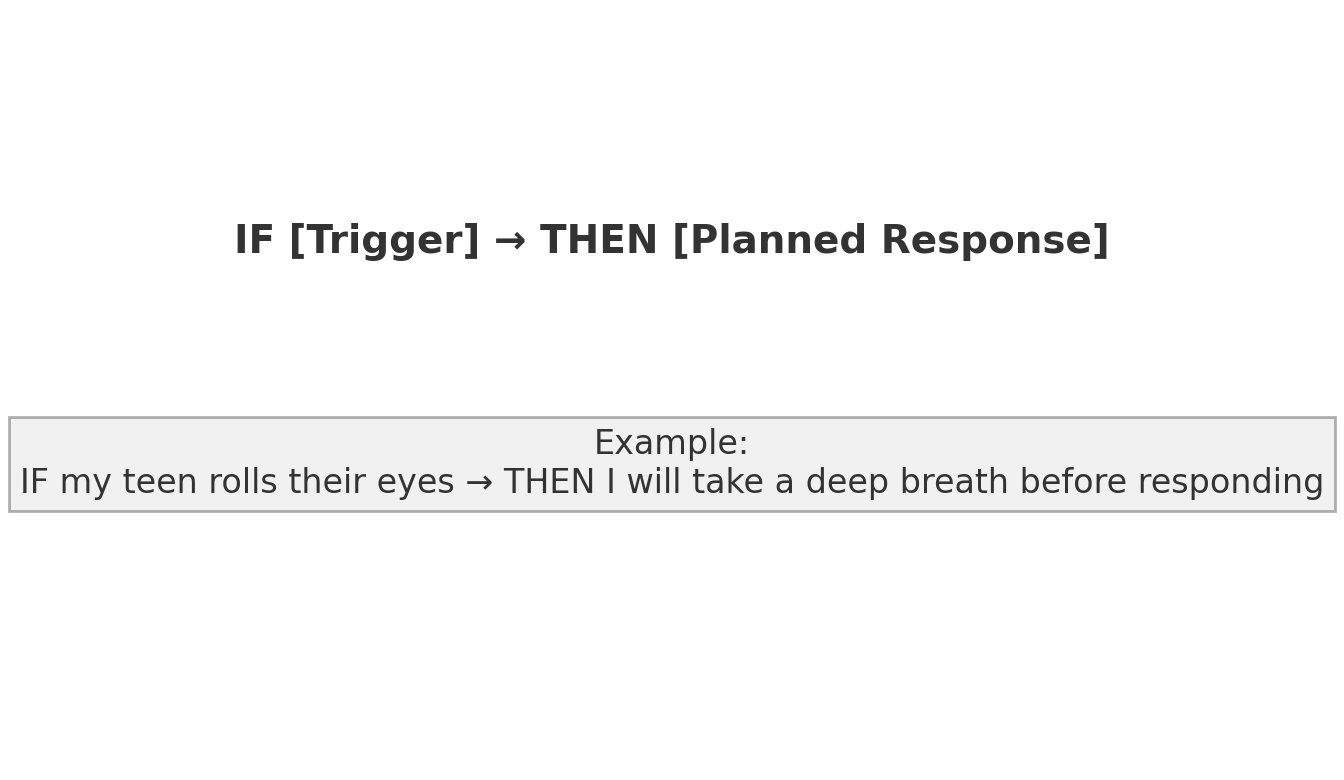
IF [Trigger], THEN [Planned Response]
By setting a clear if-then statement, you’re programming your brain to automatically take a specific action when a certain situation arises. Instead of reacting emotionally, you follow the plan—removing decision fatigue and making it easier to stay consistent.
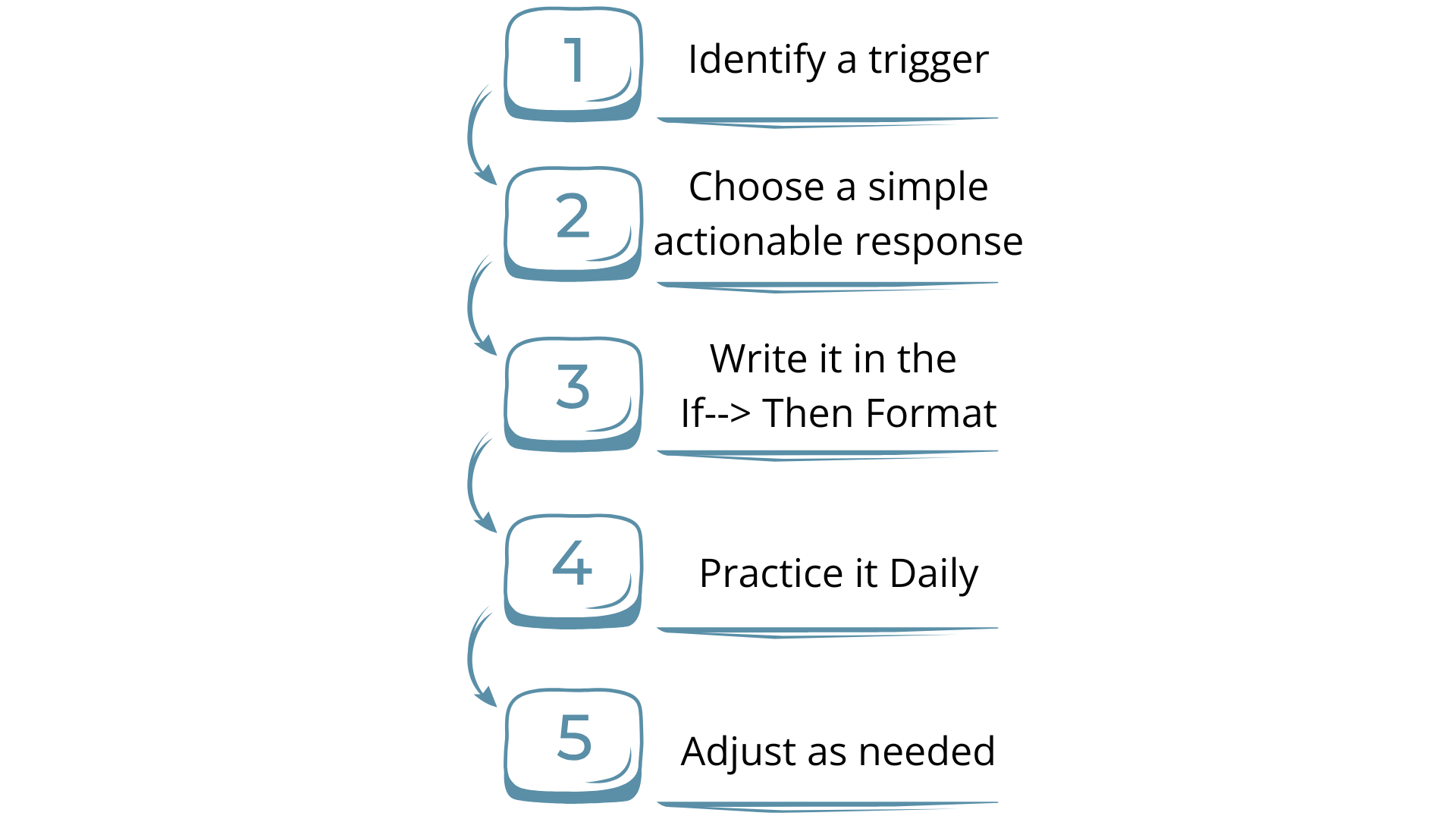
Step 1: Identify Your Trigger
A trigger is a specific situation that tends to throw you off track in your parenting.
- What moments tend to escalate into conflict?
- When do you find yourself reacting instead of responding?
- What parenting goal do you struggle to follow through on?
Examples of triggers:
✔️ Your teen rolling their eyes at you
✔️ Your child raising their voice when frustrated
✔️ Your teen ignoring your requests
✔️ You feeling overwhelmed at the end of the day
Step 2: Choose Your Planned Response
Once you’ve identified your trigger, the next step is to pre-decide how you want to respond. This should be:
✅ Specific (not vague like “I’ll be more patient”)
✅ Actionable (an actual step you can take)
✅ Realistic (something you can do in the moment)
Examples of implementation intentions:
✔️ If my teen rolls their eyes, then I will take a deep breath before responding.
✔️ If my child yells, then I will lower my voice instead of matching their volume.
✔️ If I start feeling overwhelmed, then I will drink a glass of water before addressing the situation.
Step 3: Practice and Adjust as Needed
Like any new habit, implementation intentions take practice before they become second nature.
💡 Test it out – Try your if-then statement in real-life situations.
💡 Make adjustments – If a response isn’t working, tweak it to fit your needs.
💡 Start small – Focus on one implementation intention at a time before adding more.
Why This Formula Works
✅ Removes uncertainty – You don’t have to think about what to do in the moment.
✅ Reduces emotional reactions – You act from intention, not impulse.
✅ Builds consistency – Repeating the same response makes it second nature.
Your Turn: Create Your First Implementation Intention
Think about a common parenting challenge you face. Using the formula, write your own if-then statement:
If ____, then I will _____.
Coming up next: real-life examples of how parents have used this formula to transform their daily interactions.
Real-Life Parenting Examples
Understanding the concept of implementation intentions is one thing—but seeing them in action is where the real magic happens. Let’s look at three common parenting struggles and how simple if-then plans can transform the way you respond.
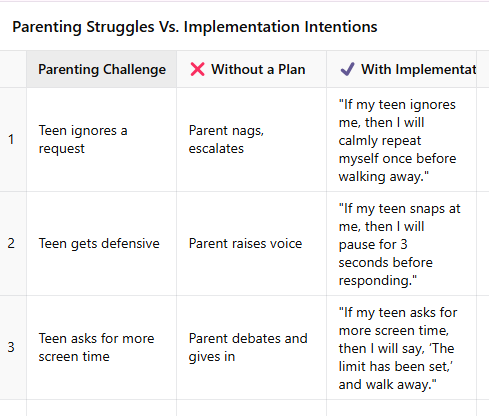
Example 1: Sticking to Screen-Time Limits Without Caving
The Struggle:
Your teen begs for “just 10 more minutes” of screen time every night, and you often give in because you’re exhausted from arguing.
Your Implementation Intention:
If my teen asks for more screen time, then I will calmly say, “The limit has been set,” and walk away.
Why This Works:
✅ Removes the pressure to debate or negotiate.
✅ Reinforces boundaries with consistency.
✅ Helps you avoid caving in just to stop the whining.
Example 2: Responding Calmly to Backtalk
The Struggle:
Your teen snaps, “Why do you always have to nag me?!” and you instantly feel disrespected, leading to an argument.
Your Implementation Intention:
If my teen responds with an attitude, then I will take a deep breath and say, “I’m here to help, not to fight.”
Why This Works:
✅ Stops you from reacting emotionally.
✅ Models the calm behavior you want to see in your teen.
✅ Shifts the dynamic from conflict to collaboration.
Example 3: Creating a Daily Connection Habit With Your Teen
The Struggle:
You want to build a closer relationship with your teen, but your days feel packed, and connection keeps slipping through the cracks.
Your Implementation Intention:
If I see my teen after school, then I will ask one open-ended question before moving on with my day.
Why This Works:
✅ Creates micro-moments of connection that add up over time.
✅ Lowers the pressure—no long conversations required.
✅ Makes connecting with your teen effortless and automatic.
Parent Success Story: Kaycee’s Breakthrough With Her Gamer Son
Kaycee, a mom in my coaching program, was struggling to connect with her 22-year-old son, who spent all his time gaming. Every attempt to start a conversation turned into an argument.
She created a simple implementation intention:
💡 If I see my son playing video games, then I will sit near him and ask, “What are you playing?” without any judgment.
At first, he barely responded. But because she stayed consistent, over time, he started opening up more. Eventually, their conversations grew beyond gaming, rebuilding their relationship in ways she never expected.
What’s Your Implementation Intention?
Think about a challenge you face with your teen. Try writing your own If-Then statement:
If ____ happens, then I will _____.
Next, we’ll walk through how to apply this strategy to your specific parenting goals today.
How to Apply This to Your Parenting Goals Today
Now that you understand how implementation intentions work, it’s time to put them into action. Here’s a simple step-by-step guide to start using this strategy in your daily parenting—without adding extra stress to your plate.
Step 1: Identify Your Biggest Parenting Challenge
Think about one area where you struggle with consistency or find yourself reacting in ways you don’t like.
Ask yourself:
✔️ When do I feel most frustrated as a parent?
✔️ What situation do I handle in a way that I later regret?
✔️ Where do I want to be more intentional in my parenting?
Examples:
- I want to stop yelling when my teen ignores me.
- I want to create a habit of checking in with my child every day.
- I want to handle defiance without escalating conflicts.
💡 Action Step: Write down one challenge that you want to address first.
Step 2: Create Your First If-Then Statement
Now, turn your challenge into a clear, actionable If-Then statement.
✔️ Keep it specific
✔️ Make it realistic
✔️ Focus on one small shift
🔹 Challenge: “I get frustrated when my teen ignores my request.”
✅ If my teen ignores me, then I will calmly repeat myself once before walking away.”
🔹 Challenge: “I want to create a stronger bond with my child.”
✅ If I see my child after school, then I will ask, ‘What was the best part of your day?’
💡 Action Step: Write your own If-Then statement using this formula:
If ____ happens, then I will _____.
Step 3: Practice and Track Your Progress
Like any new habit, implementation intentions take practice before they feel natural. The goal is to repeat the behavior until it becomes automatic.
✔️ Remind yourself daily – Write your If-Then statement somewhere visible.
✔️ Give yourself grace – If you slip up, adjust and keep going.
✔️ Celebrate small wins – Every time you follow through, you’re reinforcing a new parenting habit.
💡 Pro Tip:
Try tracking your success for one week. Each evening, ask yourself:
- Did I follow through on my If-Then statement today?
- What worked? What needs tweaking?
Step 4: Adjust as Needed
Not every plan works perfectly on the first try—and that’s okay! If your If-Then statement isn’t working, tweak it so it fits your situation better.
✔️ Too complicated? Simplify it.
✔️ Not effective? Try a different response.
✔️ Forgot to use it? Set a reminder until it becomes second nature.
Step 5: Expand to Other Parenting Goals
Once your first implementation intention is working well, you can start adding more.
✔️ Begin with one small shift and build from there.
✔️ Over time, you’ll have a toolkit of automatic parenting responses that make consistency effortless.
💡 Example:
Week 1: If my teen ignores me, then I will calmly repeat myself once before walking away.
Week 2: If my child starts raising their voice, then I will lower mine instead of matching their tone.
Week 3: If I feel myself getting overwhelmed, then I will take a 30-second pause before responding.
Your Parenting Goals, Made Easier
Parenting doesn’t have to feel like a constant battle between your intentions and your reactions.
By using implementation intentions, you’re setting yourself up for success—without relying on willpower, mental energy, or memory in the heat of the moment.
So… what’s the first If-Then statement you’re going to try?
Next, let’s cover some common mistakes parents make when using this strategy—so you can avoid them and see results faster.
Common Mistakes to Avoid
Even though implementation intentions are simple, there are a few common mistakes that can make them less effective. Avoiding these pitfalls will help you see faster results and stick with the strategy long-term.
1. Making Your If-Then Statement Too Vague
❌ “If my teen is rude, then I will handle it better.”
✔️ “If my teen uses a sarcastic tone, then I will pause for three seconds before responding.”
💡 Why It Matters:
Vague intentions don’t provide a clear action step. The more specific you are, the easier it is to follow through.
2. Trying to Change Too Many Things at Once
❌ Creating five new If-Then statements in one day.
✔️ Focusing on one at a time until it feels natural, then adding another.
💡 Why It Matters:
When you take on too much at once, it’s hard to stay consistent. Small, steady changes lead to lasting habits.
3. Choosing a Response That’s Unrealistic in the Moment
❌ “If my teen yells, then I will stay completely calm and loving no matter what.”
✔️ “If my teen yells, then I will take a deep breath and lower my voice instead of matching their tone.”
💡 Why It Matters:
You’re human. Choose a response that’s doable, even in a frustrating moment.
4. Forgetting to Remind Yourself
❌ Writing an If-Then statement but never thinking about it again.
✔️ Putting it on a sticky note, phone reminder, or journal entry to review daily.
💡 Why It Matters:
New habits take repetition. The more you remind yourself, the faster your brain adopts the response automatically.
5. Giving Up Too Soon
❌ “I tried it once, but I forgot, so it doesn’t work for me.”
✔️ “It’s okay if I forget sometimes—consistency comes with practice.”
💡 Why It Matters:
It takes repetition to build automatic responses. Every time you use an implementation intention, you strengthen the habit.
6. Not Adjusting When Something Isn’t Working
❌ Forcing an If-Then statement that isn’t effective or realistic.
✔️ Tweaking it until it fits your parenting style and situation better.
💡 Why It Matters:
Flexibility is key! If something isn’t working, adjust the plan instead of abandoning the strategy.
Final Thought: Progress, Not Perfection
You won’t get it right every time—and that’s okay. The goal is progress, not perfection. By avoiding these common mistakes, you’ll make small, powerful changes that help you become a more consistent, confident parent.
Next, let’s tie everything together with a final takeaway and an action step you can start today!
Conclusion: Small Shifts, Big Impact
Consistency in parenting isn’t about being perfect—it’s about having a plan that makes it easier to follow through, even on tough days.
By using implementation intentions, you’re setting yourself up for success:
✔️ You remove decision fatigue, so you don’t have to think on the spot.
✔️ You reduce emotional reactions, making interactions with your teen smoother.
✔️ You build better habits, leading to long-term positive change in your parenting.
The best part? You don’t have to overhaul your entire parenting approach to see results.
Just one small shift—one simple If-Then statement—can create a ripple effect in how you respond to your teen.
Over time, these micro-adjustments lead to a calmer, more connected relationship with your child.
So, what’s one If-Then statement you’ll start using today?
Next Steps
✅ Try this now: Write down one If-Then statement for a parenting challenge you face.
📩 Want more parenting strategies like this? Download my free 7-Day Family Connection Kickstart Planner to get practical, easy-to-apply tools for building a stronger bond with your teen.
💬 Let’s connect! Drop a comment below with your If-Then statement—I’d love to hear what you’re working on!
0 Comments